
| Parameter | Standard Value / Typical Specification | Remarks / Test Standard |
|---|---|---|
| Nominal Thickness | 100 mils / 2.5 mm | 1 mil = 0.001 inch |
| Width | 5.0m, 6.0m, 7.0m, 8.0m | Customizable based on manufacturing capability, typically up to 8-9m max |
| Roll Length | 50m, 100m, or custom | Longer rolls reduce the number of field seams |
| Area per Roll | e.g., 6.0m × 100m = 600 ㎡ | Actual area depends on width and length |
| Surface Texture | Smooth / Single Textured / Double Textured | Textured surfaces enhance frictional stability |
| Tensile Strength (MD/XD) | ≥ 40 kN/m | Test Standard: ASTM D6693 |
| Elongation at Break (MD/XD) | ≥ 700 % | Test Standard: ASTM D6693 |
| Tear Resistance | ≥ 200 N | Test Standard: ASTM D1004 |
| CBR Puncture Resistance | ≥ 8000 N | Test Standard: ASTM D6241 |
| Pyramid Puncture Resistance | ≥ 1000 N | Test Standard: ASTM D4833 |
| Yield Tensile Strength (MD/XD) | ≥ 22 kN/m | Test Standard: ASTM D6693 |
| Permeability Coefficient | < 1.0 × 10⁻¹³ cm/s | Test Standard: ASTM E96 |
| Carbon Black Content | 2.0% – 3.0% | Provides UV resistance; Test Standard: ASTM D1603 |
| Environmental Stress Crack Resistance (ESCR) | ≥ 1500 hours | High-stress, notched test; Critical index; Test Standard: ASTM D5397 |
| Dimensional Stability | ± 2 % | Test Standard: ASTM D1204 |
| Low Temperature Brittleness | Pass | Typically tested at -70°C; Test Standard: ASTM D746 |
| Seam Peel & Shear Strength | ≥ 85% of parent material strength | Verified via field destructive tests; Test Standard: ASTM D6392 |
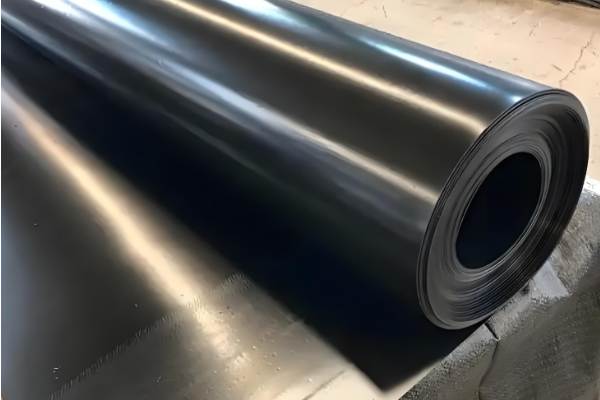
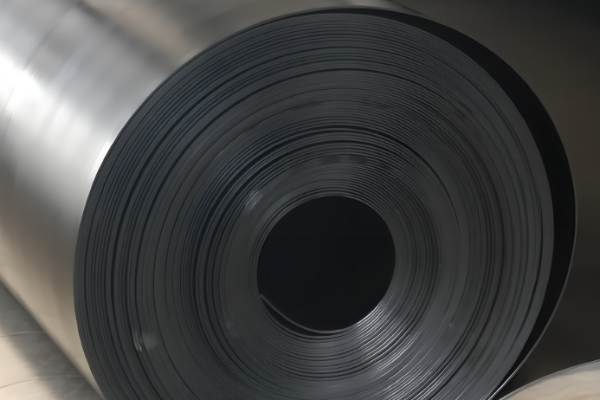
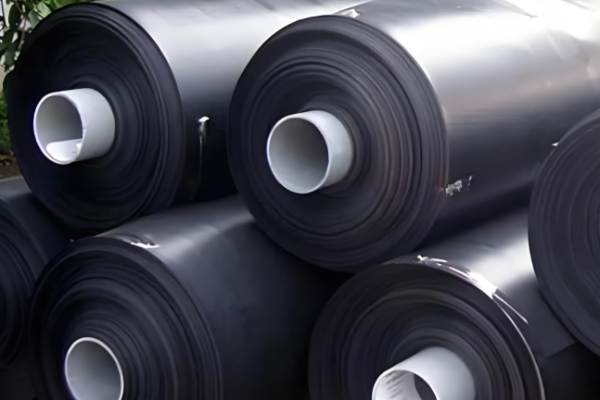
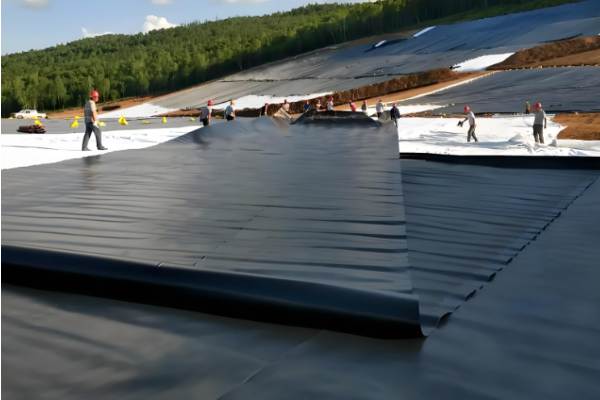
100 Mil(2.5 mm) HDPE Geomembrane
Material:High-Density Polyethylene (HDPE)
Nominal Thickness:100 mil / 2.5 mm
Shipping Method:logistics
Product Category: HDPE Geomembrane, Geomembrane
Appearance:Black (due to carbon black additive)
Price:The price of 100 Mil(2.5 mm) HDPE Geomembrane is not fixed and is influenced by various factors. For more details, please consult us.
The 100-mil (2.5mm) HDPE geomembrane is a high-performance polymeric impermeable liner, renowned as the “backbone of containment engineering” due to its exceptional durability, strong chemical resistance, and extremely low permeability. With a thickness of 2.5mm, it is the preferred material for heavy-duty, large-scale, and long-life environmental and hydraulic projects. Manufactured through an extrusion calendering process, this product is tough and designed to withstand harsh physical and chemical environments. It is widely used in critical containment applications such as landfills, mining operations, and large reservoirs.
Performance
The 100-mil (2.5mm) HDPE geomembrane significantly outperforms thinner gauges. Its core performance metrics include:
Very Low Permeability: Hydraulic conductivity is typically less than 1.0 × 10⁻¹³ cm/s, making it a near-perfect fluid and vapor barrier, effectively isolating contaminants, harmful liquids, and gases.
Outstanding Mechanical Strength:
Tensile Strength: Typically ≥ 40 kN/m (machine and cross-machine directions), enabling it to withstand foundation settlement and external loads.
Elongation at Break: ≥ 700%, providing high ductility to accommodate subgrade changes without brittle failure.
Tear Resistance: ≥ 200 N (CBR Puncture Resistance ≥ 8000 N), offering high resistance to puncture and tearing from sharp objects.
Excellent Chemical Resistance: HDPE is highly resistant to a wide range of acids, alkalis, salts, oils, and organic solvents. Its chemical inertness ensures long-term stability in aggressive environments like landfill leachate and industrial wastewater.
Superior Environmental Stress Crack Resistance (ESCR): This is a critical property, indicating the material’s ability to resist cracking under stress in the presence of chemicals. 100-mil HDPE geomembrane exhibits excellent ESCR (per ASTM D5397), ensuring long-term service reliability.
Excellent UV Resistance: The added carbon black allows for long-term exposure to sunlight without significant degradation (typical designed service life exceeds 50 years).
Good Weldability: Can be seamed in the field using dual-track hot wedge or extrusion welders to form a continuous, robust monolithic liner, with seam strength achieving over 80% of the parent material strength.
Application
Due to its superior overall performance, 100-mil HDPE geomembrane is primarily used in projects with the highest requirements for containment integrity and long-term safety:
Environmental Containment:
Base liners and final cover systems for solid waste landfills (municipal, hazardous, and industrial).
Liners for wastewater treatment plants, equalization ponds, and evaporation ponds.
Mining Industry:
Liners for heap leach pads, tailings impoundments, solution ponds, and red mud stacks, preventing contamination of groundwater by heavy metals and acidic effluents.
Water Conservancy & Hydropower Projects:
Liners for potable water reservoirs, artificial lakes, and irrigation canals.
Cutoff walls in dams and levees.
Other Civil Engineering Projects:
Secondary containment in petrochemical facilities.
100 mil (2.5 mm) HDPE geomembrane is used for waterproofing in tunnels and underground engineering.


