- What is Geotextile Filter Fabric?
- Is Filter Cloth the Same as Geotextile?
- Main Types of Geotextile Filter Fabric
- Key Specifications of Geotextile Filter Fabric
- Application of Geotextile Filter Fabric
- How to Choose the Right Geotextile for Your Project?
- How to Choose the Best Geotextile Filter Cloth?
- Installation Steps of Geotextile Filter Cloth
- Conclusion
When constructing driveways,installing drainage systems,or landscaping gardens,have you ever struggled with gravel sinking into the soil or drainage ditches clogging with silt?The solution to these common engineering problems often lies in a key material—geotextile filter fabric.This comprehensive guide provides a complete analysis of how to correctly select and use geotextile cloth,covering everything from its principles to types,specifications,and applications.
What is Geotextile Filter Fabric?
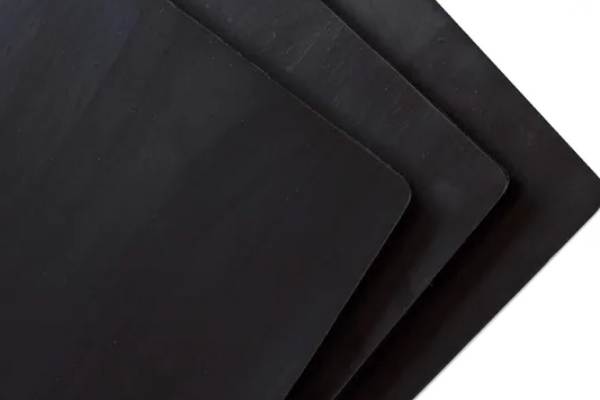
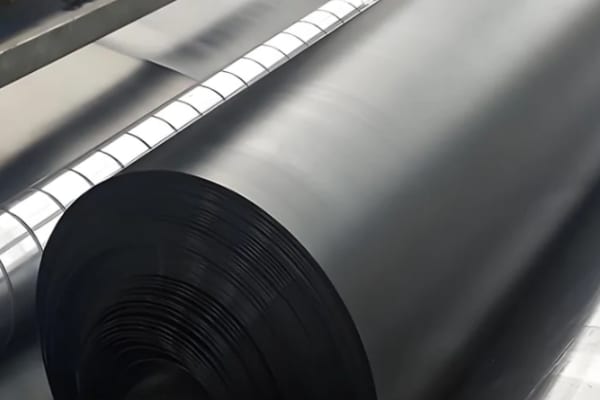
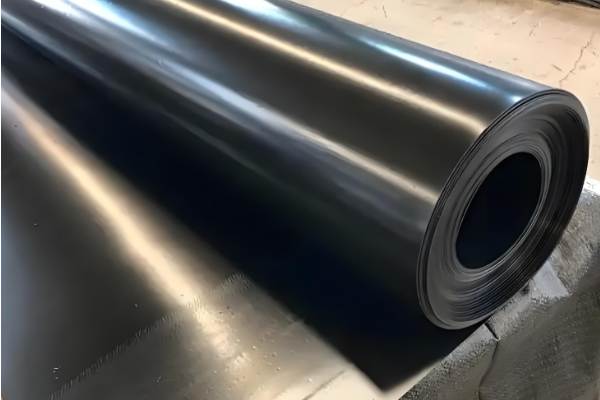
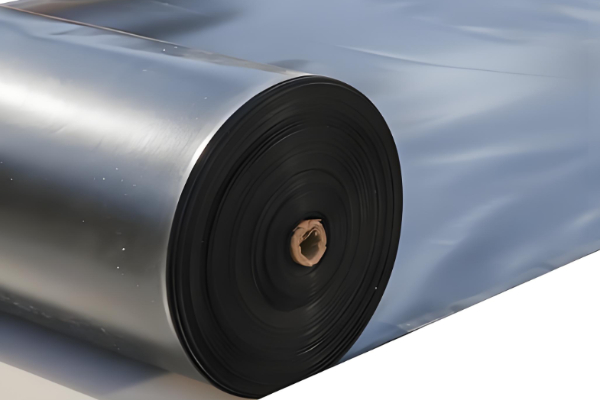
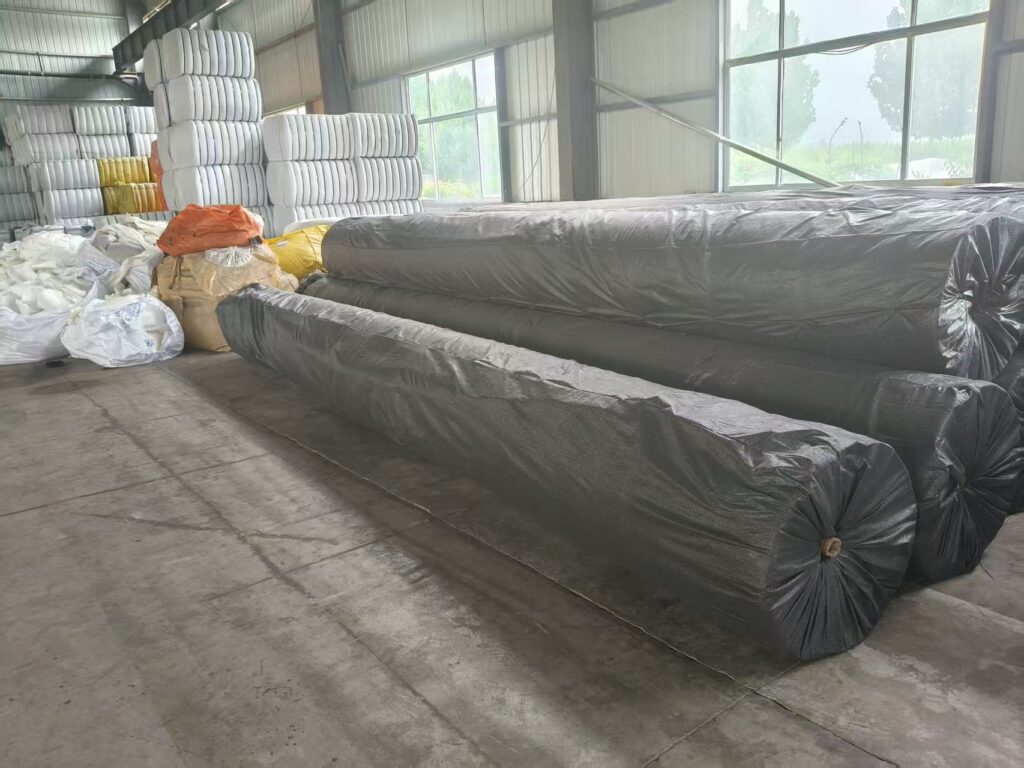
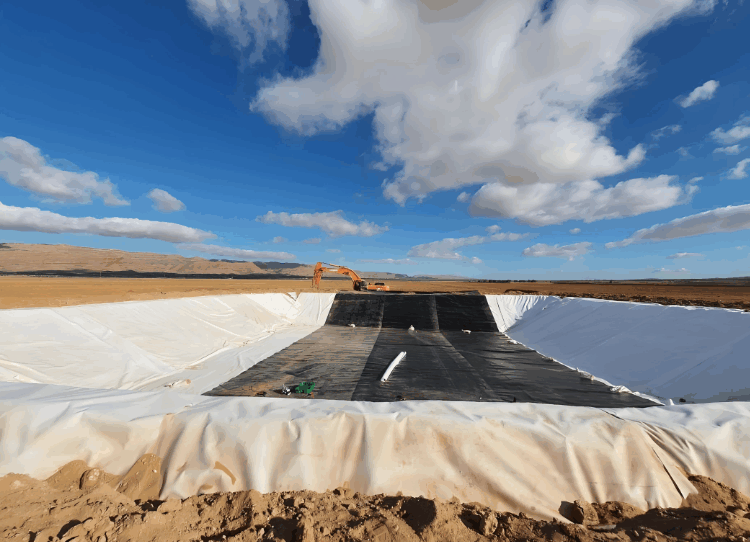
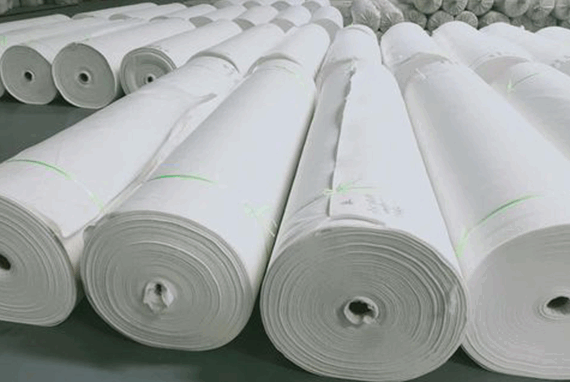
Geotextile filter fabric,commonly referred to as geotextile,is a permeable textile material made from synthetic fibers like polypropylene or polyester through processes such as needle-punching or weaving.It is widely used in civil engineering,landscaping,and environmental projects,serving four core functions:
Separation : Prevents the mixing of different soil types or materials(e.g.,gravel and soft soil),maintaining the structural integrity of each layer.
Filtration : Allows water to pass through freely while effectively retaining soil particles,preventing erosion and clogging.
Drainage : Collects and channels water along its plane,facilitating lateral drainage.
Reinforcement : Distributes loads,enhancing the overall stability and load-bearing capacity of the soil.
Is Filter Cloth the Same as Geotextile?
Not exactly.They have a”subset”and”superset”relationship.
“Geotextile”is a broad term encompassing all synthetic textiles used in geotechnical engineering,with functions including reinforcement,protection,and separation.
“Filter fabric”specifically refers to the type of geotextile whose primary function is filtration.It emphasizes the characteristic of allowing water passage while retaining soil particles.
Conclusion : In most drainage and landscaping applications,what people are looking for as”geotextile”is essentially”geotextile filter fabric.”However,in applications like roadbed reinforcement where high strength is prioritized over filtration,the reinforcement function is more emphasized.
If you are purchasing Geotextile Filter Fabric, you can contact us!
Main Types of Geotextile Filter Fabric
Based on manufacturing process and structure,geotextiles are primarily divided into two main categories with distinct performance characteristics and suitable applications.They are Needle-Punched Non-Woven Geotextile and Woven Geotextile Fabric.
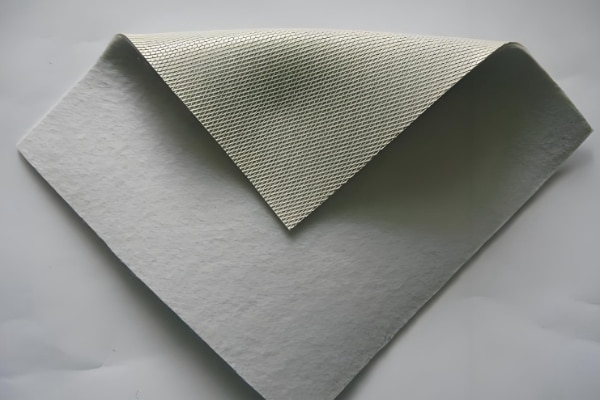
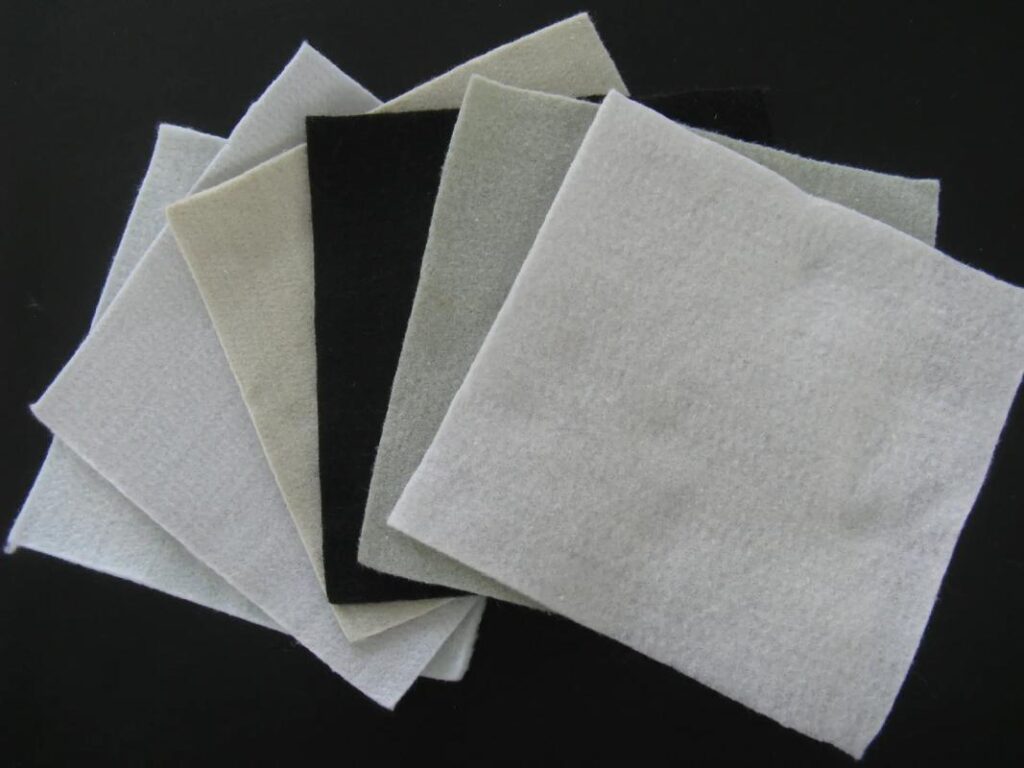
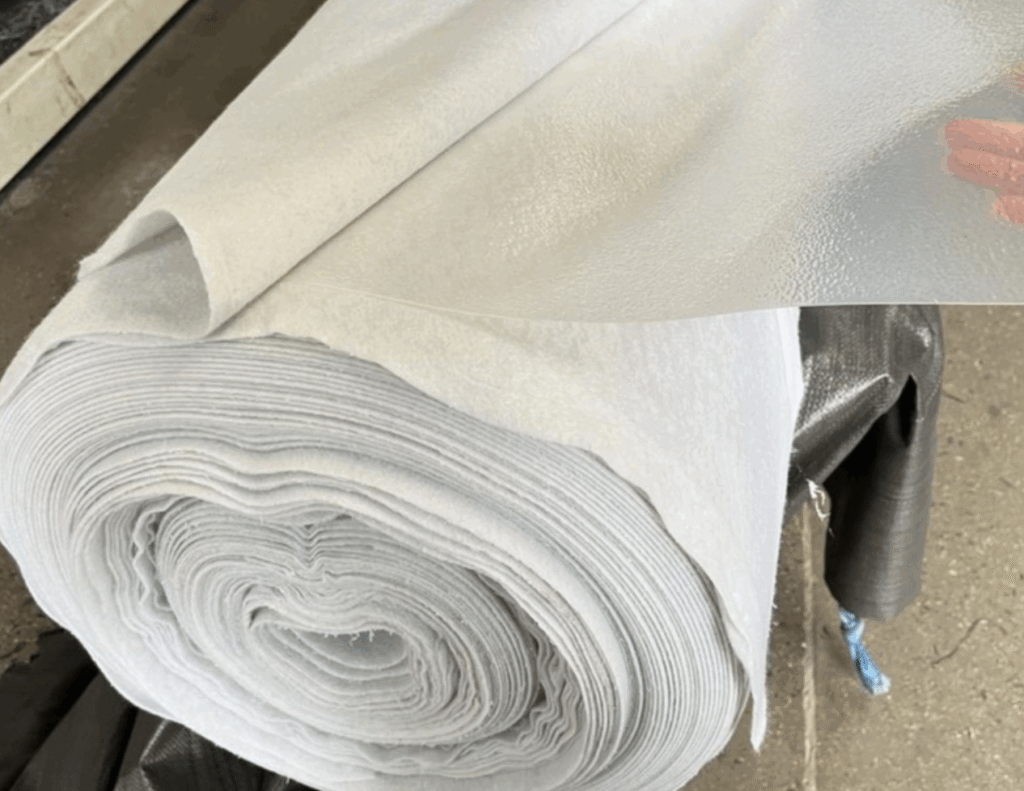
Needle-Punched Non-Woven Geotextile is manufactured by carding fibers into a web and then entangling them through needle-punching.It resembles felt in appearance,is soft and fluffy to the touch,and offers excellent permeability.This isotropic structure ensures consistent performance in all directions.Its main functions are focused on filtration,drainage,and protection,making it highly suitable for applications requiring good water permeability,such as drainage systems,retaining wall drainage,pipe wrapping,and landscaping.
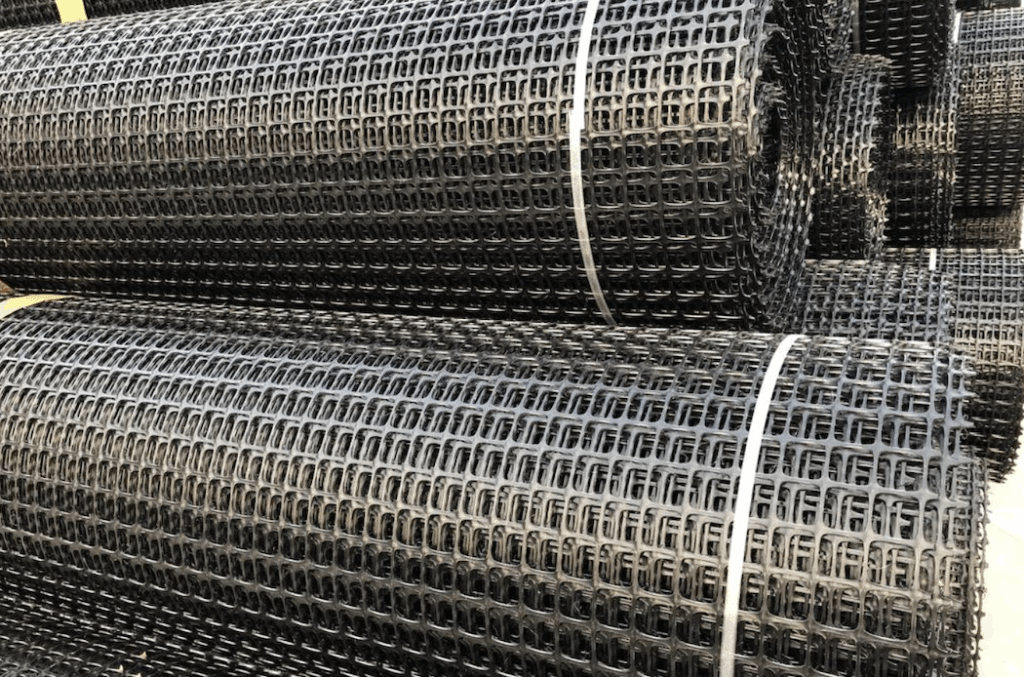
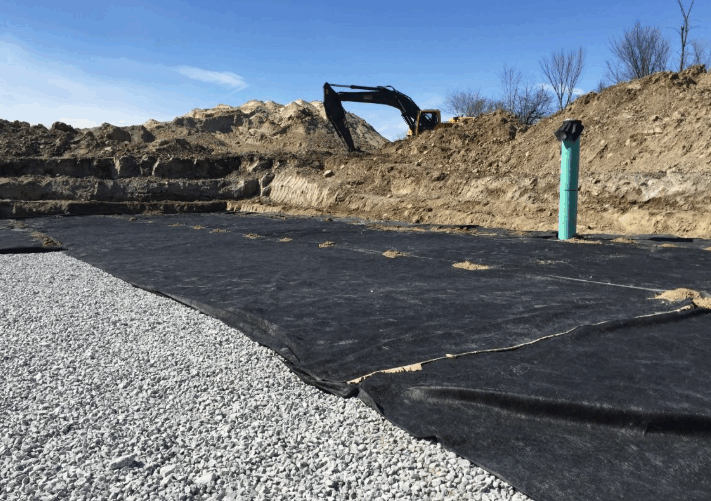
Woven Geotextile Fabric is produced by interlacing yarns or tapes,resulting in an appearance similar to woven bags with a smooth surface and regular texture.This structure provides high tensile strength and low elongation,offering outstanding ultimate tensile strength.Woven geotextiles are primarily used for separation and reinforcement applications,making them particularly suited for scenarios requiring high load-bearing capacity,such as driveway construction,parking lots,road base stabilization,and soil reinforcement projects.
Key Specifications of Geotextile Filter Fabric
Selecting the right geotextile shouldn’t rely on feel or thickness alone;it must be based on scientific technical specifications.Understanding these parameters is key to making the correct choice.
Physical Properties:
Mass per Unit Area : Measured in grams per square meter(g/m²)or ounces per square yard(oz/yd²).This is the most basic indicator,often correlating positively with thickness and strength.For example,a 200 g/m²fabric is generally heavier and more durable than a 100 g/m²fabric.
Mechanical Properties(Crucial for Separation and Reinforcement applications):
Tensile Strength : Measured in kilonewtons per meter(kN/m).Indicates the maximum tensile force the fabric can withstand before failure.A higher value signifies greater resistance to tearing and deformation,which is vital for projects like driveways and base stabilization.
Elongation at Break : Measured as a percentage(%).Indicates how much the fabric stretches before breaking.
Hydraulic Properties(Crucial for Filtration and Drainage applications):
Apparent Opening Size(AOS) : Measured in millimeters(mm)or U.S.Sieve Number.This is the core parameter for filtration function,representing the approximate size of the pores in the fabric.A smaller AOS indicates the ability to retain finer soil particles.Selection must be based on the particle size distribution of the soil being protected(typically requiring AOS to be smaller than the diameter of the base soil particles).
Permittivity/Permeability : Permeability coefficient is measured in centimeters per second(cm/s).Represents the ability of water to flow through the geotextile filter cloth vertically.A higher value indicates better drainage capacity.
Specification Selection Advice:
For Drainage Filtration : Prioritize Apparent Opening Size(AOS)and Permeability.
For Driveway Reinforcement : Prioritize Tensile Strength and Mass per Unit Area.
Application of Geotextile Filter Fabric
1、Applications in Road Construction
Elaborate on the specific roles of geotextile filter fabric as a separation,filtration,and stabilization layer in road construction.
Provide examples of its application cases and effects in different types of roads,such as gravel roads,unpaved roads,expressways,and railway tracks.
Analyze its contributions to road durability,reduction of maintenance costs,and other related aspects.
2、Applications in Drainage Systems
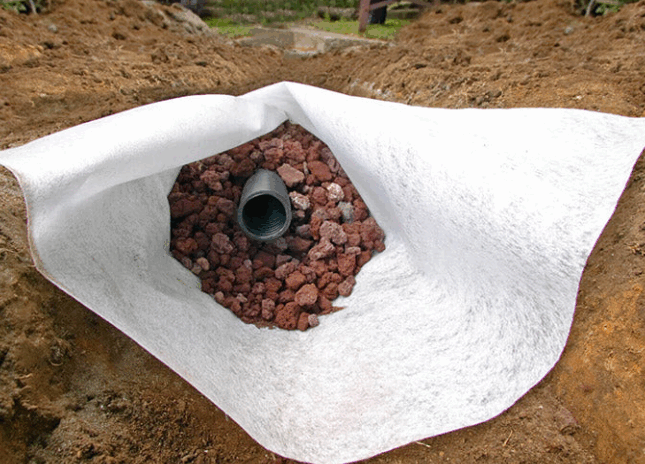
Focus on explaining its application in French drains,including installation methods,the principle of preventing clogging,and its impact on the service life of drainage systems.
Elaborate on the application methods and advantages of geotextile filter fabric in scenarios such as groundwater drainage behind retaining walls,drainage in planter boxes and green roofs,and underground drainage trenches.
3、Applications in Soil Erosion Control
Explain how to prevent soil erosion in construction projects,such as the role of silt fences made of geotextile filter fabric installed around construction sites.
Analyze the mechanism and effects of geotextile filter fabric cooperating with other protective measures to prevent soil erosion in coastal and riverbank areas.
How to Choose the Right Geotextile for Your Project?
The selection process can be simplified into two steps:
Step 1:Determine the Type Based on Application
Projects Prioritizing Filtration and Drainage:French drains,drainage ditches,retaining wall drainage,pond liner protection→Choose Needle-Punched Non-Woven Geotextile.
Projects Prioritizing High-Strength Separation and Stabilization:Driveways,parking lots,beneath road bases,load-bearing platforms→Choose Woven Geotextile Fabric.
Step 2:Determine Required Parameters Using Specification Knowledge
Driveway Projects:Should select a Woven Geotextile with Tensile Strength≥20 kN/m.
Drainage Projects:Should select a Non-Woven Geotextile with AOS≤0.3 mm and Mass per Unit Area between 120-200 g/m².
How to Choose the Best Geotextile Filter Cloth?
In geotextile selection,the most important principle is : There is no single”best”product,only the”most suitable”one for your specific project requirements,soil conditions,and budget constraints.
Precise Selection Based on Project Type:
For drainage and filtration applications(e.g.,French drains,catch basins,retaining wall drainage),the optimal choice is a medium-weight(120-200 g/m²)needle-punched non-woven geotextile.The key parameter is the Apparent Opening Size(AOS),typically selecting a specification between 0.15-0.25mm to ensure effective soil retention while maintaining excellent water permeability.The permittivity should be greater than 10⁻²cm/s to ensure drainage efficiency.
For driveway and parking lot construction,high-strength woven geotextile fabric is the unequivocal choice.Focus on tensile strength(recommended≥20 kN/m)and CBR puncture strength.These projects require the geotextile to have excellent separation功能functionality,preventing the mixing of the gravel base with the soft subgrade,while enhancing the load-bearing capacity of the subsoil through load distribution,thereby extending the road’s service life.
In landscaping and gardening projects,the choice depends on the specific use.For weed suppression beneath flower beds,a lighter weight(90-120 g/m²)non-woven landscape fabric can be chosen,which allows water and air permeability while inhibiting weed growth.For base stabilization under rocks or paving stones,a slightly heavier non-woven fabric(120-150 g/m²)is needed to provide better protection and separation.
Soil Conditions Dictate the Final Choice:
Selecting geotextile filter cloth must also consider local soil conditions.In silty or clayey areas,a geotextile with a smaller AOS(around 0.15mm)is required to prevent clogging caused by the loss of fine particles.In sandy soils,a product with a slightly larger AOS(0.2-0.3mm)can be used.Remember a basic rule:the aperture size of the geotextile should be smaller than the diameter of 85%of the particles in the soil being protected.
Balancing Cost-Effectiveness and Durability:
Finally,consider the project’s expected lifespan.Temporary projects(e.g.,construction access roads)can use lower-specification products,while permanent works(e.g.,municipal roads)should invest in more durable,high-quality geotextile materials,paying attention to performance indicators such as UV resistance,chemical resistance,and biodegradation resistance.
Installation Steps of Geotextile Filter Cloth
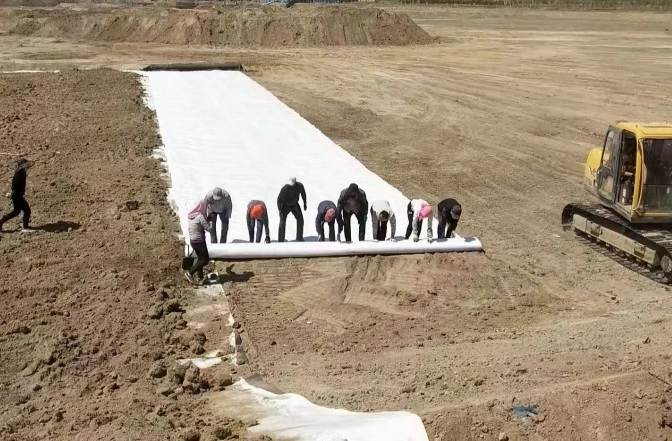
Proper installation is the final step to ensure the geotextile fabric performs effectively.
Site Preparation : Clear and grade the base surface,removing any debris,roots,or sharp objects that could puncture the geotextile.
Placement Direction : Unroll the geotextile with the machine direction(roll length)perpendicular to the primary direction of flow or traffic.
Overlap Seams : Provide sufficient overlap between adjacent rolls,typically 30-50 cm(12-20 inches),to ensure continuity.
Anchoring : On slopes or areas prone to wind or water movement,secure the fabric using”U-shaped pins”or landscape staples to prevent displacement.
Cover and Protect : Backfill with covering material(e.g.,gravel or sand)immediately after installation.Avoid prolonged exposure to UV rays to prevent degradation.Place backfill material gently from a low height to prevent mechanical damage.
Conclusion
Geotextile filter fabric is a classic example of a”small investment,large return”material in modern engineering.It significantly extends project lifespan and reduces maintenance costs.The key to successful application lies in selecting the correct type,understanding the specifications scientifically,and installing it properly.We hope this guide helps you make the most informed decision for your next project.
If you are looking for a reliable Geotextile Filter Fabric supplier,please feel free to contact us.
About Us:Lianjie
Lianjie is a one-stop supplier of geosynthetics with 15 years of professional experience and multiple national certifications.We provide the most professional Geotextile Filter Fabric solutions!
References:
- ASTM D4439 – Standard Terminology for Geosynthetics : Provides standard terminology definitions for geosynthetic materials (including geotextiles), serving as the basis for distinguishing between “geotextile” and “filter fabric”.
- ASTM D5261 – Standard Test Method for Measuring Mass per Unit Area of Geotextiles : Defines the test method for measuring mass per unit area (basis weight).
- ASTM D4632 – Standard Test Method for Grab Breaking Force and Elongation of Geotextiles : Defines the test methods for grab tensile strength and elongation at break.
- ASTM D4751 – Standard Test Method for Determining Apparent Opening Size (AOS) of a Geotextile : Defines the test method for determining the Apparent Opening Size (AOS).
- ASTM D4491 – Standard Test Methods for Water Permeability of Geotextiles by Permittivity : Defines the test methods for water permeability/transmissivity.
- ISO 10318 – Geosynthetics — Terms and definitions : International Organization for Standardization terminology standard for geosynthetic materials.
- GRI (Geosynthetic Research Institute) Test Methods : A series of widely accepted supplementary test standards.